Airlines and Startups Deploy AI in Aviation Operations
United Airlines, Reliable Robotics, and NASA officials detail how automation is entering cockpits, crew scheduling, and airspace management—and where it's deliberately being kept out.
Airlines and Startups Deploy AI in Aviation Operations
Aviation leaders are moving beyond theoretical debates about artificial intelligence to tackle a harder problem: integrating advanced automation into live operations without disrupting the complex systems that move hundreds of thousands of passengers daily.
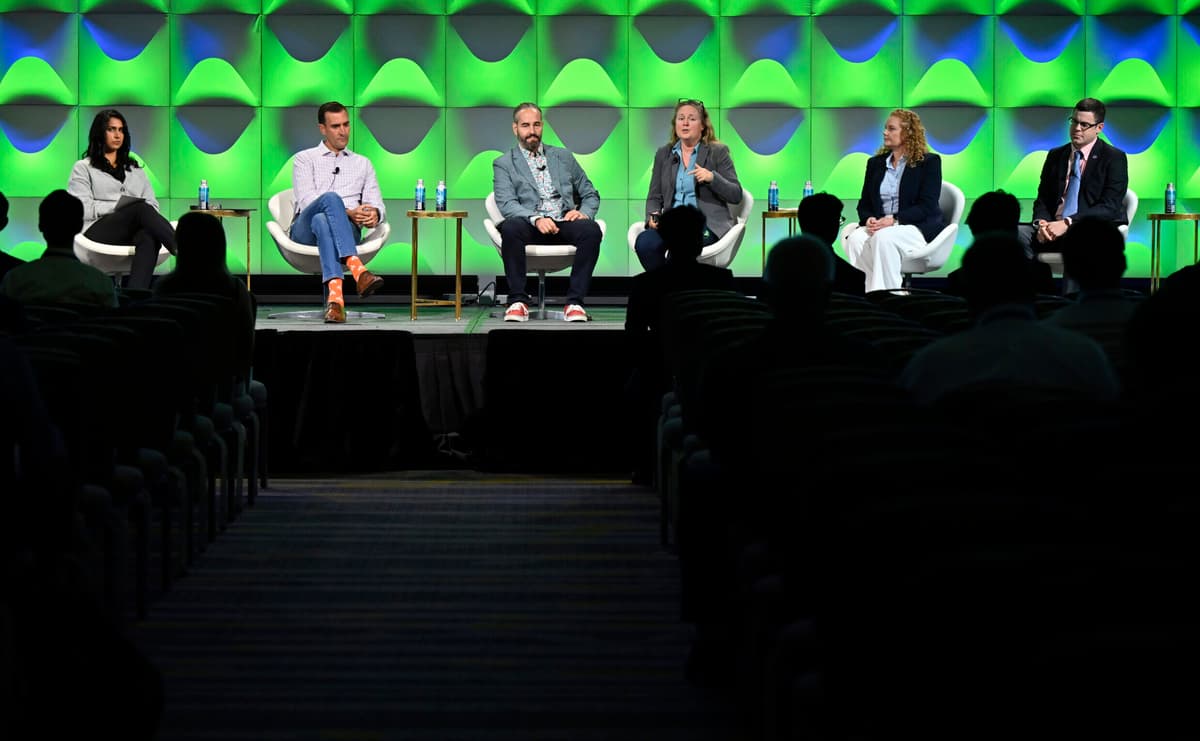
At the AIAA AVIATION Forum in San Diego, executives from United Airlines, Reliable Robotics, Collins Aerospace, NASA, and standards organizations outlined where AI and autonomy are already changing decision-making—and the certification, trust, and integration challenges that remain.
Why it matters
The aviation industry handles over 45,000 flights daily in U.S. airspace alone, with safety standards that leave no room for probabilistic "best guesses." How operators thread AI into this environment—choosing which functions to automate, which to leave deterministic, and how to certify the difference—will shape whether advanced automation accelerates or stalls in one of the world's most safety-critical industries.
United Airlines layers AI onto existing networks
United Airlines is embedding AI into daily operations at scale, according to Roberta Zimmerman, the carrier's director of Air Traffic Strategy, Data Analytics, and Strategic Vision. The airline operates 5,359 daily departures and recently flew 630,500 passengers in a single day, its highest on record.
United is deploying AI where it reduces friction without touching safety-critical decisions. The airline uses AI to communicate flight-by-flight delay explanations to passengers, offer rebooking alternatives, and predict gate-to-gate walking times at connecting airports. The carrier is also applying AI to crew scheduling, translating complex labor contract rules into scheduling logic.
Zimmerman emphasized that humans remain in the loop. The real barrier, she said, isn't algorithm maturity—it's systems integration. She cited a seemingly trivial airport code change (Palm Beach International switching from PBI to DJT) as requiring massive internal coordination to prevent continuity loss across interconnected systems.
Reliable Robotics keeps AI out of flight-critical code
Reliable Robotics is taking a different approach: embedding automation directly into aircraft while deliberately excluding AI from the flight-critical stack. Brandon Suarez, vice president of UAS Integration, described the company's Reliable Autonomy System, which can guide aircraft through all flight phases without an onboard pilot.
In a 2023 demonstration at Hollister, California, a Cessna Caravan was controlled by a remote pilot 50 miles away. The preproduction system handles taxi, takeoff, and landing using GPS, inertial navigation, and radar altimeters, targeting roughly 2,000 U.S. airports with LPV approach capability.
Suarez explained why AI remains off the table for now: "AI as a tool that needs to go through a certification process is basically a non-starter for a startup company, because there are no rules and procedures and standards to follow." Instead, Reliable uses classic software coding languages and deterministic algorithms that regulators can verify.
Certification, he noted, is fundamentally about explainability—convincing a disinterested expert that the system works as intended. The company operates Reliable Airlines, a Part 135 cargo carrier in Albuquerque that will be the first operator of the automated system.
Collins Aerospace experiments in low-criticality zones
Collins Aerospace is threading intelligence into avionics, cockpits, and cabin systems, according to Travis Klopfenstein, innovation program manager. The supplier is testing technologies like ATC speech-to-text conversion in experimental flight decks and "Galley AI" that uses optical sensing to track cabin inventory and passenger needs.
Collins groups AI efforts on a spectrum of complexity versus criticality, clustering early deployments in low-criticality applications while working through certification questions for higher-stakes functions. Klopfenstein emphasized the importance of high-fidelity modeling and simulation—potentially using commercial game engines—for both operations and eventual certification.
NASA and standards bodies define safety frameworks
Chester Dolph, an engineer at NASA Langley Research Center, outlined a future where urban air mobility vehicles, drones, supersonic aircraft, and traditional jets share increasingly dense airspace. NASA's work focuses on strategic air traffic management, safe routine operations when GPS or data links fail, and defining failure scenarios so AI systems can be validated.
Any AI-driven system, Dolph said, must be generalizable, reproducible, and explainable—able to articulate when and why it works or fails.
Standards consultant Anna Dietrich, former COO of Terrafugia, identified a fundamental challenge: deciding how reliable autonomous systems must be compared to humans. "We give people a lot of grace to screw up," she said. "We're not giving the systems that same grace."
These details were first reported by Aerospace America following the AIAA AVIATION Forum panel discussion.
This is an original analysis by the Omega editorial team. Source reporting: Automation Watch.
Want systems like this working for your business?
Book a Call