AI-Written Op-Eds Remain Rare at Top Publications, Analysis Finds
Detection tools flagged only 10 of 310 recent guest columns as heavily AI-generated, though debate continues over quality and disclosure.
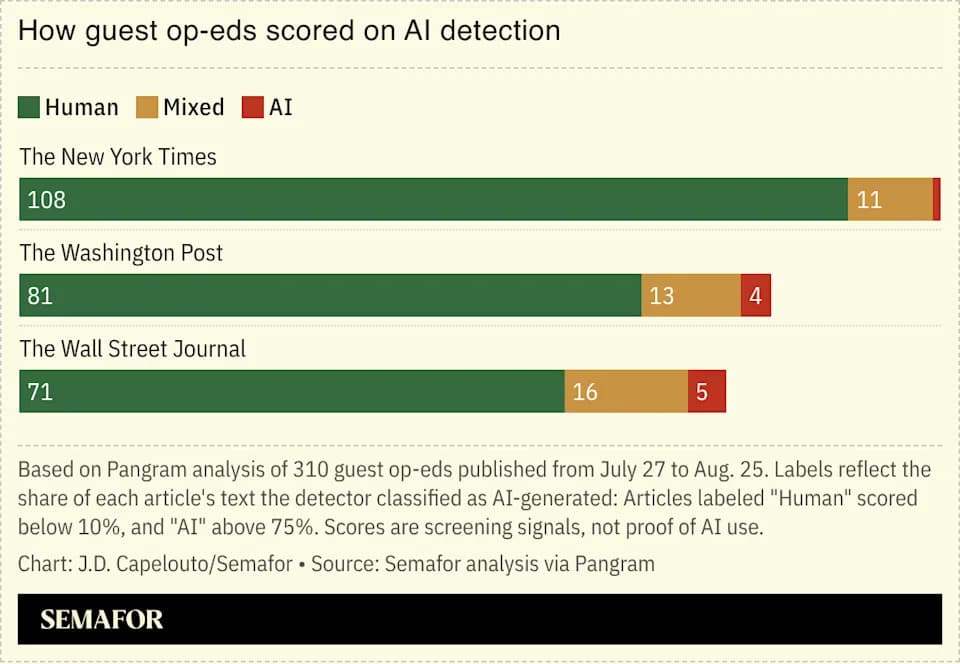
AI Writing Still Marginal in Prestige Opinion Pages
Artificial intelligence has made limited inroads into the opinion sections of America's most influential newspapers, according to an analysis first reported by Semafor. Using the AI detection tool Pangram, researchers examined 310 guest submissions published over the past month across The Wall Street Journal, The Washington Post, and The New York Times. Only 10 pieces—roughly 3%—registered as at least 80% AI-generated. Another 40 showed partial AI involvement.
The findings arrive amid fresh controversy over AI disclosure in opinion journalism. Billionaire investor Stanley Druckenmiller recently confirmed he used AI to draft a Wall Street Journal op-ed criticizing Treasury Secretary Scott Bessent's bond market interventions. The piece, which Pangram scored as 100% AI-written, displayed characteristic markers of machine-generated text but achieved its intended impact in financial circles.
"I write everything using AI now for the same reason I use a calculator when I do math problems," Druckenmiller told NOTUS, noting his shift from English to economics during college.
WSJ opinion editor Paul Gigot defended the publication, stating that AI is "a fact of modern life" and emphasizing that what matters is whether content "reflects an author's original argument" and the author's credibility.
Policy Gaps and Detection Challenges
The three publications maintain different stances on AI use. The New York Times explicitly prohibits AI in "developing and drafting guest essays," yet Pangram flagged a piece by former CISA director Jen Easterly as AI-generated. The Washington Post requires guest writers to confirm submissions weren't "created or manipulated with artificial intelligence," though 17 articles showed AI involvement according to the analysis.
Detection accuracy remains contested. Pangram claims a 0.5% false positive rate, and Semafor's informal testing found it reliable. However, Stanford research suggests detection tools may disproportionately flag non-native English speakers. Santiago Schnell, Dartmouth's provost and a native Spanish speaker, acknowledged using ChatGPT to "refine arguments" and check grammar in a Washington Post column that Pangram marked as 100% AI-written.
Why it matters
The low adoption rate suggests quality concerns and reputational risk still outweigh convenience for most contributors to elite publications. Current language models produce serviceable but mediocre prose—a "lowest common denominator" that fails to meet the standards writers and editors maintain for prestige platforms. As AI labs prioritize commercially valuable capabilities like legal analysis over literary refinement, the gap between human and machine writing quality may persist longer than many predicted.
The Quality Ceiling
Frontier AI labs are concentrating development efforts on reliable business applications rather than writing excellence, according to Semafor's analysis. The path to better AI writing may require models that can learn continuously—updating their parameters over time like humans developing vocabulary and taste—rather than remaining static after initial training.
Until such capabilities emerge, writers face a choice between human effort and "good-enough" AI output. Michigan researchers found that while general audiences sometimes prefer AI-generated content, MFA-trained experts consistently favor human writing unless AI models are fine-tuned on high-quality examples.
The details in this analysis were first reported by Semafor.
This is an original analysis by the Omega editorial team. Source reporting: AI Watch.
Want systems like this working for your business?
Book a Call