AI World Model Startups Hit 80% Chip Utilization on AWS Trainium
Physics-simulating models achieve double the industry-standard compute efficiency, revealing a new class of infrastructure customer beyond language AI.
A new class of AI customer is emerging on AWS
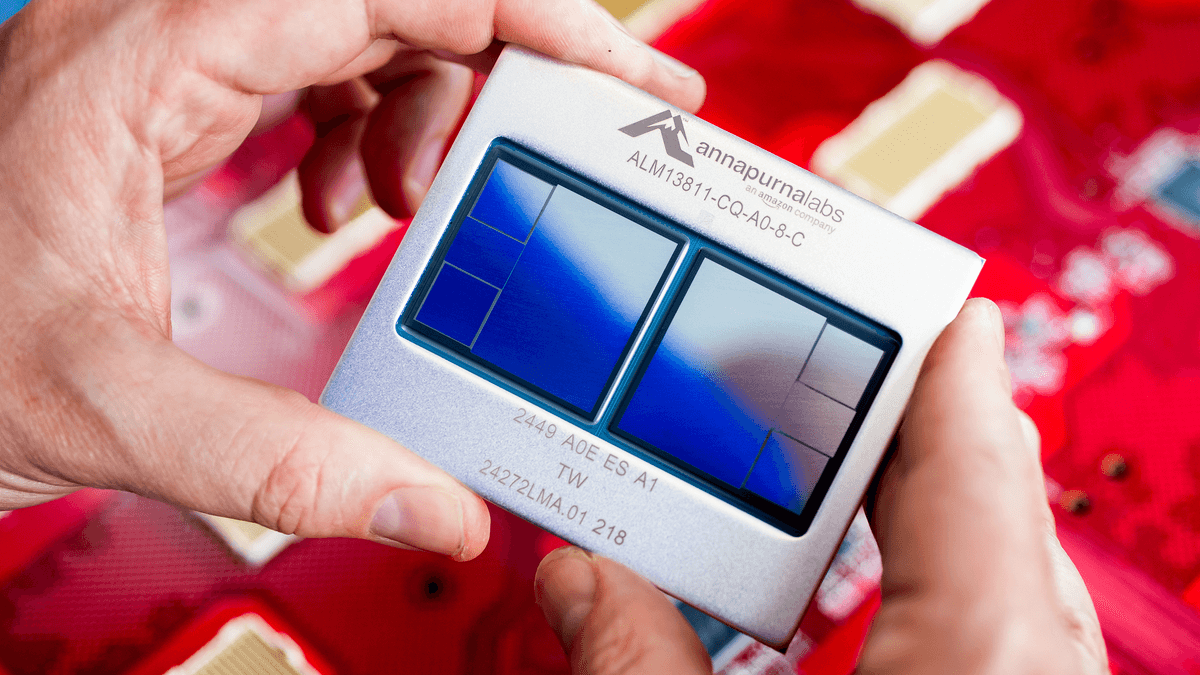
While Anthropic and OpenAI make headlines for their partnerships with Amazon Web Services, a different category of AI startup is quietly demonstrating why custom silicon matters beyond language models. Companies building world models—AI systems that simulate physics and real-world environments rather than generate text—are achieving unprecedented compute efficiency on AWS Trainium chips.
Odyssey, a startup focused on physics simulation, recently hit 80% model flop utilization (MFU) on Trainium3 hardware, according to details first reported by Amazon. That metric measures how much of a chip's theoretical peak performance translates into real workload throughput. In an industry where 40 to 50% MFU is considered well-optimized, Odyssey's result means extracting nearly twice the useful compute per dollar spent.
Ron Diamant, the vice president and distinguished engineer leading Amazon's Trainium development, called Odyssey's team "very, very impressive," noting they achieved the optimization largely independently.
Why world models demand different infrastructure
World models predict the next frame of a scene—accounting for gravity, light, motion, and object interactions—rather than the next word in a sequence. Applications span robotics, autonomous vehicles, game engines, and industrial simulation.
Unlike large language models that can be trained in bursts, world models require long, uninterrupted compute runs at sustained high utilization. Cost per useful compute becomes the defining economic metric, making thermal management and sustained performance critical infrastructure requirements.
Diamant explained that Amazon invests across the full stack—from software to thermal and power delivery solutions—to ensure Trainium maintains high utilization over extended training runs without overheating, a challenge that limits many competing accelerators.
General-purpose design enables novel architectures
Trainium wasn't optimized for a single model type. Amazon's chip team studied transformers, vision encoders, diffusion models, and world models, then generalized the underlying compute primitives into a flexible instruction set.
"We're not building a transformer or world-model accelerator, that's not our approach," Diamant said. The team works backward from workload requirements to primitives, then generalizes an instruction set that still accelerates diverse architectures exceptionally well.
That design philosophy pays dividends as startups arrive with novel model structures. Each world model varies slightly, and Trainium's generalized approach enables high performance without extensive custom optimization.
Beyond Odyssey: a growing cohort
DeCart AI has publicly shared strong results training on Trainium for real-time generative video, achieving quadruple the performance of conventional chips. Neura Robotics is using Trainium for physical AI development as part of its AWS partnership. Splash Music reduced training costs by up to 50%, enabling music creation tools priced for independent artists. Poolside powers inference for its code-generation models through Trainium on Amazon Bedrock.
AWS offers both Trainium and Nvidia GPUs, giving customers infrastructure choice based on workload requirements. For startups building compute-intensive AI beyond chatbots, that choice increasingly points toward Amazon's custom silicon.
Why it matters
The shift from language models to world models represents one of AI's most compute-intensive frontiers, with implications for robotics, simulation, and interactive systems. Achieving 80% chip utilization—versus the industry standard of 40-50%—translates directly to training cost advantages that determine which startups can scale economically. As AI applications diversify beyond text generation, infrastructure efficiency becomes a competitive moat.
Details in this report were first published by Amazon.
This is an original analysis by the Omega editorial team. Source reporting: AI Watch.
Want systems like this working for your business?
Book a Call