AI Supply Chain Circularity Creates Systemic Financial Risk
A new analysis maps how interconnected financing and revenue dependencies among 255 AI companies could amplify shocks across the sector.
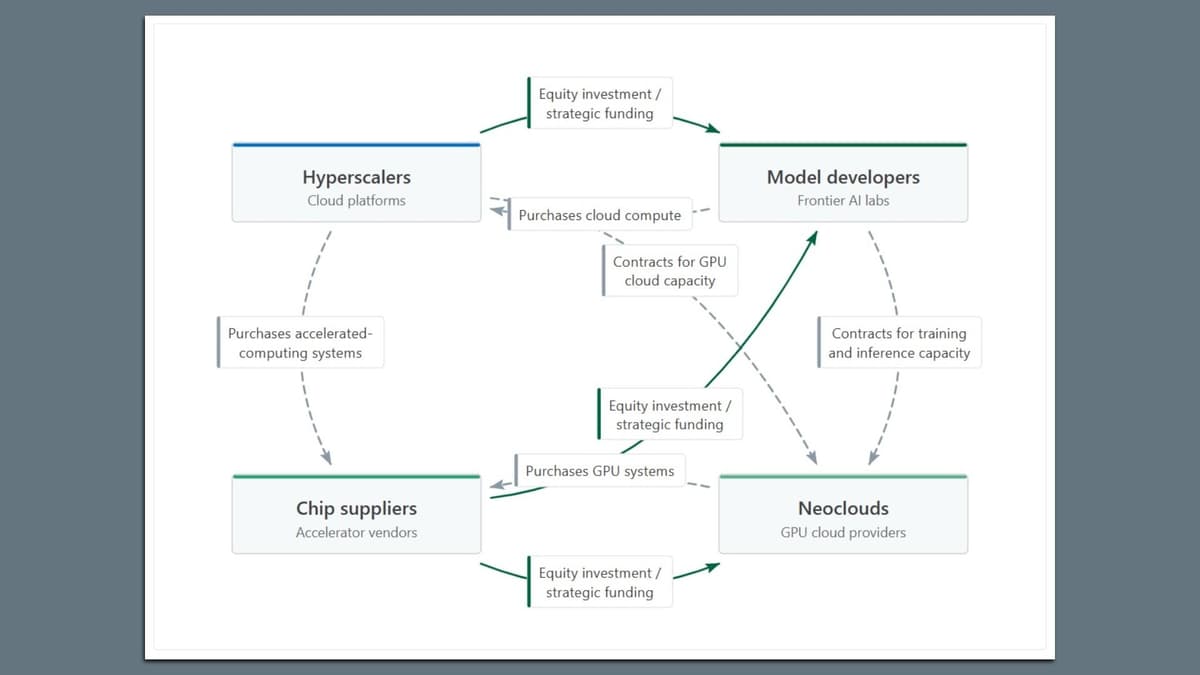
Financial fragility in the AI ecosystem
The artificial intelligence sector's explosive growth has created a tightly interconnected web of financial dependencies that could amplify disruptions across the entire industry, according to new research from London-based Sona Asset Management.
The analysis, first reported by the Financial Times, examined 255 public companies in the AI supply chain—from hyperscalers like Microsoft and Meta to chipmaker Nvidia, plus smaller data center operators and cloud computing providers. Together, these firms represent $50 trillion in combined market capitalization and carry nearly $6 trillion in debt.
Why it matters
AI investment has become a pillar of U.S. economic growth, and the sector's structural vulnerabilities arrive at a moment when borrowing costs are rising and credit quality among major cloud providers is weakening. The New York Times reports that concerns about market stability have influenced the Trump administration's resistance to AI regulation, with officials worried that constraints on AI development could trigger broader economic fallout.
The circular money flow
Sona's researchers describe the AI market as operating like "a closed loop" where capital, products, and demand circulate among the same companies. These firms finance one another, purchase from each other, and cross-invest—creating what the authors compare to "air through an office HVAC system."
The concentration is stark among smaller players. CoreWeave derives approximately 67% of its revenue from Microsoft alone. Applied Digital, a data center infrastructure company, gets 56% of revenue from Oracle and 30% from CoreWeave—which itself depends heavily on Microsoft.
The Sona authors draw parallels to the pre-2008 mortgage market, citing "opaque and concentrated exposures, counterparties linked in complex ways that few have mapped, and demand part-underwritten by the same balance sheets that depend on it."
Where the vulnerabilities lie
The analysis identifies the greatest financial risk not among the core hyperscalers and chipmakers—which generate strong cash flows and maintain solid credit ratings—but rather "one ring out from the core." Neoclouds and data center platforms operate with the highest leverage, thinnest profit margins, and weakest cash flows.
These smaller firms face existential risk from single investment decisions by larger partners or from technological advances that could drive down the price of computing power.
Important distinctions
The researchers note key differences from the financial crisis. The AI sector builds and sells physical assets rather than creating synthetic leverage. Unlike the mortgage collapse, individual homeowners and their livelihoods aren't directly at stake. The core companies remain financially healthy.
Yet the structural circularity and concentrated dependencies mean a disruption at one node could cascade through the system in ways that are difficult to predict or contain.
The analysis from Sona Asset Management was highlighted in the Financial Times, with additional context reported by the New York Times and Axios.
This is an original analysis by the Omega editorial team. Source reporting: AI Watch.
Want systems like this working for your business?
Book a Call