AI Medical Assistants Guide Troops Through Battlefield Trauma
Ukrainian and US teams are developing offline and cloud-based tools to help soldiers treat injuries when medics aren't available.
AI Medical Assistants Guide Troops Through Battlefield Trauma
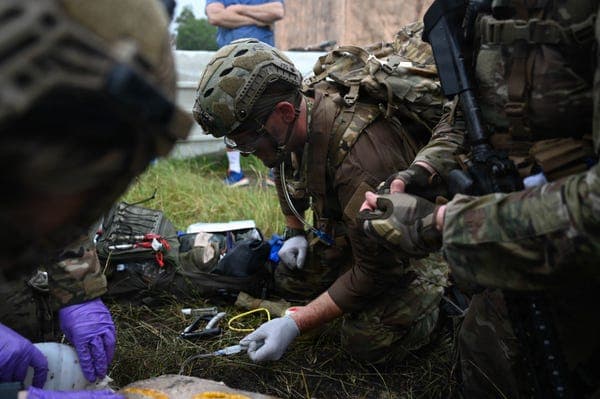
Modern warfare has created a dangerous gap between where soldiers fight and where they can receive medical care. As drone-dominated battlefields force troops into smaller, more dispersed units, wounded personnel may find themselves far from trained medics with no immediate evacuation option. Two new AI-powered tools aim to bridge that gap by providing real-time trauma guidance directly to soldiers in the field.
The Ukrainian military is testing ALICE, a Tactical Aid Assistant app developed by trauma surgeon Roman Kuziv, who commands the eastern Medical Forces and Sustainment Group. Built on Google's Gemini platform, ALICE allows soldiers to photograph injuries, answer follow-up questions, and receive immediate tactical combat casualty care protocols. The app includes separate modes for medics and non-medics, with voice prompts designed to help stressed users follow proper procedures under fire.
Meanwhile, researchers at the University of Pittsburgh's Center for Military Medicine Research have developed FieldCare GPT, an experimental chatbot that addresses a critical constraint: it works entirely offline. Led by retired military trauma surgeon Travis Polk, the team designed the tool to operate locally on high-performance laptops, eliminating the electromagnetic signatures that cellphones and radios produce—signatures that enemy forces can detect and use for targeting.
FieldCare GPT draws on established military medical references including the 75th Ranger Regiment Medic Handbook and Tactical Combat Casualty Care guidelines. Users can type or dictate injury descriptions and receive step-by-step guidance linked directly to source documents. The offline capability comes with tradeoffs: unlike ALICE, FieldCare GPT doesn't currently support image identification, though the Pittsburgh team is working toward a version that could use laptops as mobile servers for smaller devices.
Why it matters
The shift away from guaranteed rapid evacuation represents a fundamental change in military medical planning. US troops fighting post-9/11 wars in the Middle East could typically expect quick casualty evacuation, but the realities of peer conflict—demonstrated daily in Ukraine—have eliminated that certainty. The US military is now preparing for prolonged casualty care scenarios lasting days or weeks, where medics or even non-medical personnel may need to sustain wounded troops far longer before evacuation becomes possible. These AI tools represent an attempt to extend medical knowledge to the point of injury, potentially saving lives when traditional medical support chains break down.
Both development teams emphasize their tools aren't meant to replace medical personnel or training. Instead, they provide guidance when no other options exist—helping untrained service members control catastrophic bleeding, apply chest seals to gunshot wounds, or manage tourniquets correctly. Stacy Shackelford, an emergency medicine professor and former director of the military's Joint Trauma System, described these tools as "decision assist" technologies that could augment memory and help with difficult choices, particularly when used within a medic's scope of practice.
The technology faces significant testing ahead. FieldCare GPT has been evaluated against 200 battlefield injury prompts and shown to military personnel, with hands-on testing planned to see how actual soldiers interact with the system. ALICE is undergoing similar field testing with Ukrainian medics, who are identifying gaps for developers to address.
These details were first reported by Business Insider.
This is an original analysis by the Omega editorial team. Source reporting: AI Watch.
Want systems like this working for your business?
Book a Call