AI-Generated Video Falsely Shows Imran Khan in Pakistan Court
Detection tools and visual errors exposed synthetic footage circulating as Khan's legal team challenged his detention conditions.
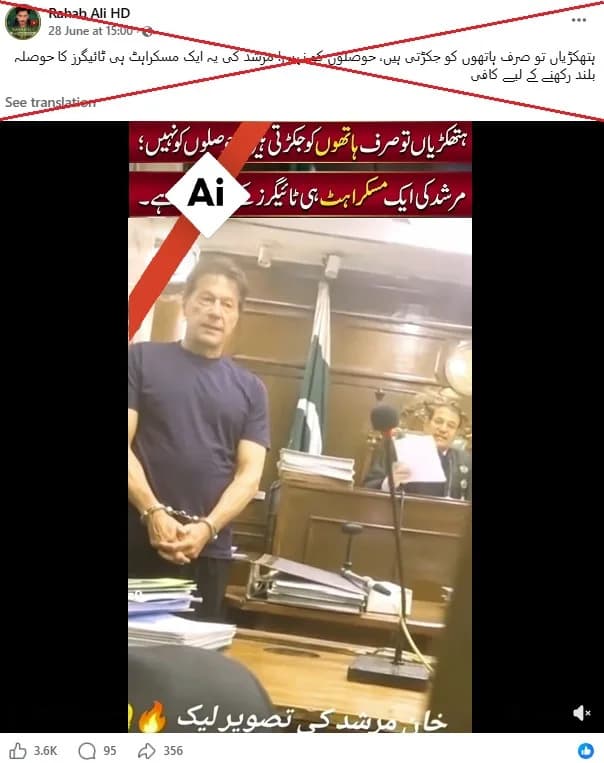
Synthetic courtroom footage spreads amid detention challenge
A video purporting to show Pakistan's imprisoned former prime minister Imran Khan appearing in court has been exposed as AI-generated content, according to analysis by detection tools and visual examination. The footage circulated on Facebook and other social media platforms in late June 2026 as Khan's legal representatives challenged the conditions of his detention.
The short clip depicts a figure resembling Khan with handcuffed wrists addressing a courtroom. "The cuffs only restrain the hands, not morale," read part of the Urdu-language caption accompanying the June 28 post. Similar videos showing the same clothing and courtroom setting spread across multiple Facebook accounts.
Visual errors reveal fabrication
Close inspection of the footage reveals telltale signs of synthetic generation. At the clip's opening, the subject's thumbs appear to merge together unnaturally. The handcuffs themselves break apart visually when hands are raised—a rendering error characteristic of AI video generation.
The DeepFake-o-Meter detection tool, developed by the University at Buffalo, analyzed the video and indicated a high probability of AI generation across its detection models. Additional circulating clips purporting to show Khan in court contained inconsistencies in courtroom positioning and the judge's changing appearance between videos.
Context of detention challenge
Khan has been incarcerated since 2023 and received a 17-year corruption sentence in December 2025 alongside his wife, charges both deny. The fabricated videos emerged as Khan's sister Aleema filed a petition describing his detention conditions as unlawful and inhumane.
According to Dawn, a Pakistani news outlet, the petition stated Khan had been confined in solitary for 22 hours daily, while his wife Bushra Bibi allegedly faced 24-hour isolation. The filing also claimed the couple had been denied family visits for months and raised concerns about Khan's deteriorating eyesight.
On June 30, Justice Khadim Hussain Soomro ordered the petition and a similar filing by Bushra Bibi's daughter to be formally registered, scheduling a future hearing to determine legal admissibility. No official reports have documented Khan making recent court appearances.
Why it matters
The spread of AI-generated political content during active legal proceedings demonstrates how synthetic media can exploit information gaps and public interest in high-profile cases. When official information is limited—as with Khan's restricted access and closed detention—fabricated content can fill the void and shape public perception. For technology leaders and policymakers, this case underscores the operational challenge of detecting and countering synthetic media at scale, particularly in politically charged contexts where verification resources may be limited.
These details were first reported by AFP's fact-checking service.
This is an original analysis by the Omega editorial team. Source reporting: AI Watch.
Want systems like this working for your business?
Book a Call
