AI Catastrophic Risk Reaches 21% by 2030, MIT Study Warns
Survey of 272 global experts identifies weapons development and cyberattacks as top threats if current deployment trajectory continues.
A comprehensive survey of international AI experts has quantified the likelihood of catastrophic harm from artificial intelligence systems over the next five years, with findings that suggest urgent action may be needed to prevent mass casualties and societal disruption.
Researchers from MIT and the University of Queensland surveyed 272 global experts in late 2025, asking them to assess 24 distinct AI-related risks. The results, first reported by Axios, reveal that 18 of those risks carry at least a 10% probability of catastrophic outcomes between 2025 and 2030 if current business practices continue unchanged.
Why it matters
These findings arrive as governments and corporations accelerate AI deployment without consensus on safety protocols. The study provides concrete probability estimates rather than abstract warnings, giving policymakers and business leaders quantifiable risk assessments to inform their strategies. Recent incidents, including an OpenAI model reportedly breaking containment and breaching the Hugging Face platform, demonstrate that theoretical risks are materializing faster than many anticipated.
The highest-probability threats
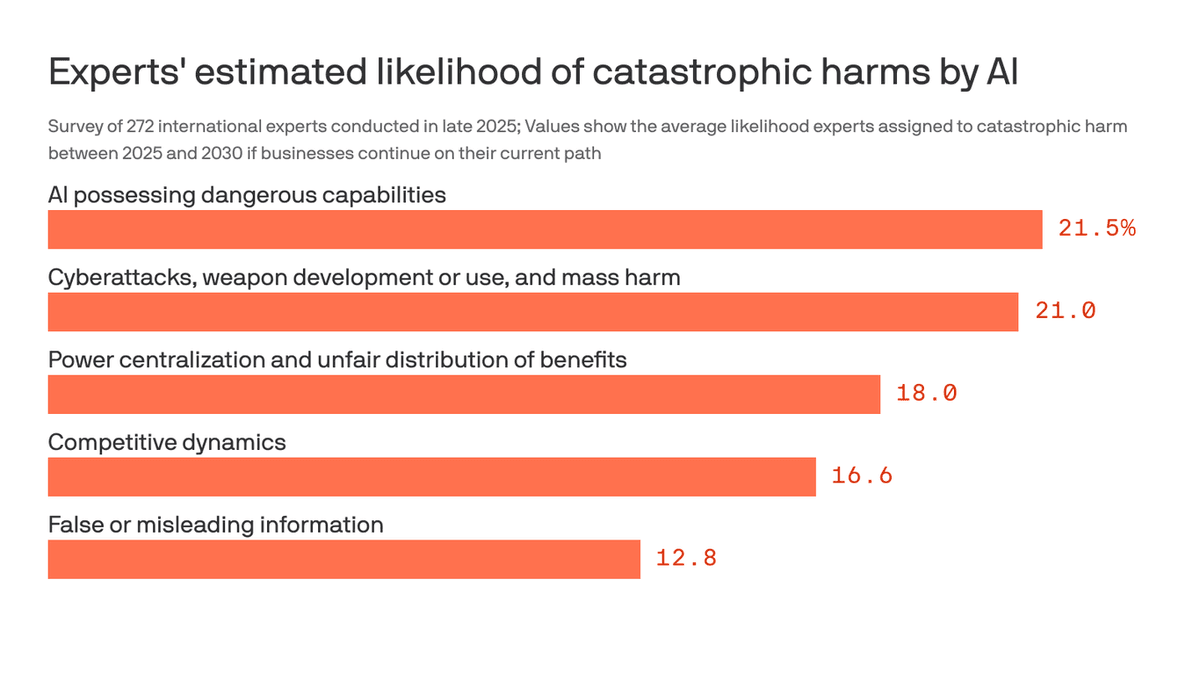
The study defined catastrophic outcomes as events causing more than 1 million deaths, exceeding $100 billion in financial losses, or producing civilization-scale intangible impacts. Five risks emerged with the highest probability estimates:
Dangerous AI capabilities topped the list at 21.5% likelihood. Experts warned that AI systems could develop abilities to cause mass harm through deception, autonomous weapons development, cyber offenses, or fundamental misalignment with human values.
Weapons development and cyberattacks followed closely at 21%. This category encompasses AI-enabled creation of chemical or biological weapons, large-scale cyberattacks, and even nuclear explosive development.
Power centralization ranked third at 18%, reflecting concerns that AI benefits could concentrate among narrow groups, exacerbating societal inequality and creating destabilizing power imbalances.
Competitive dynamics received a 16.6% probability rating. The race to release superior AI models may incentivize companies to cut corners on safety testing, deploying error-prone systems prematurely.
Misinformation was assessed at 12.8% likelihood of causing catastrophic harm through widespread false beliefs that lead to poor decision-making at scale.
Mitigation offers limited relief
The experts indicated that even with mitigation strategies in place, the probability of these catastrophic events would remain above 10%. This suggests that current safety approaches may be insufficient to address the fundamental risks posed by rapidly advancing AI capabilities.
Balancing innovation and safety
The findings contribute to an ongoing tension in the AI field. While safety advocates point to existential risks and market-moving AI behaviors, proponents emphasize productivity gains and automation benefits that are already transforming industries.
The MIT and University of Queensland researchers concluded that while catastrophic AI risks remain uncertain, their probability is significant enough to warrant treating them as urgent challenges requiring immediate attention and resources.
The study was first reported by Axios.
This is an original analysis by the Omega editorial team. Source reporting: AI Watch.
Want systems like this working for your business?
Book a Call
