AI Bubble Risk Lies in Deployment Gap, Not Technology Failure
Memory pricing, infrastructure bottlenecks, and the lag between capital commitments and revenue generation reveal where market correction could begin.
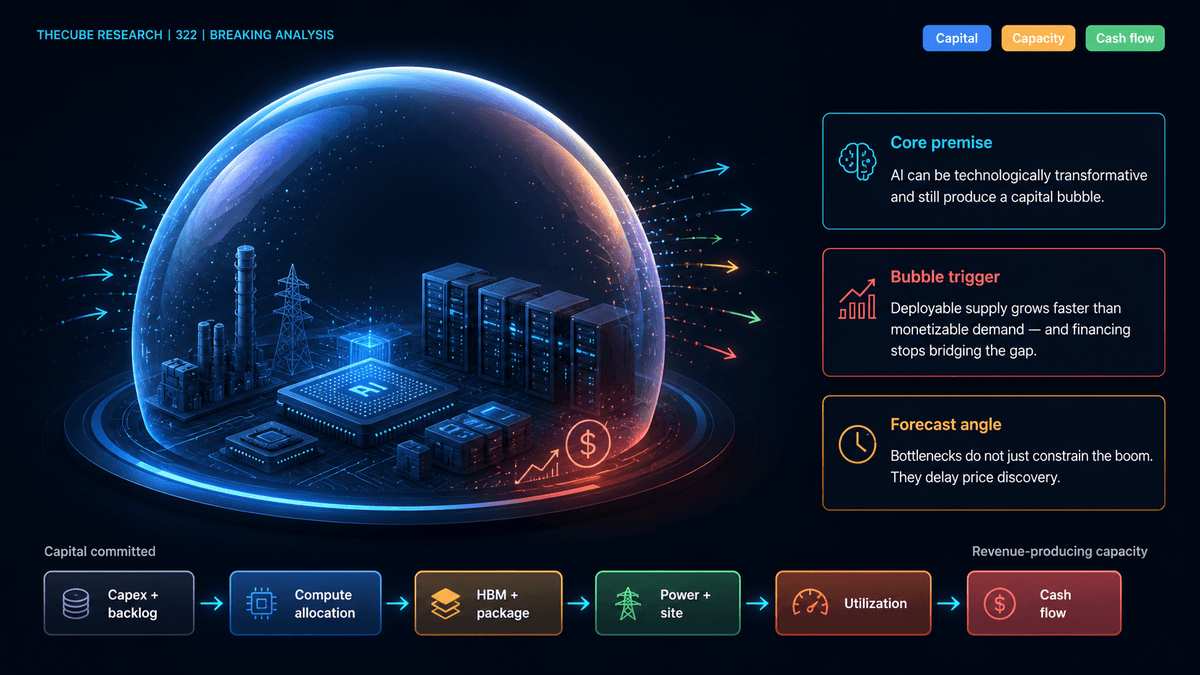
The AI capital cycle faces a timing problem
Artificial intelligence can transform industries while simultaneously creating a capital bubble—these outcomes are not mutually exclusive. The critical question is not whether AI works, but whether deployable supply and capital commitments are growing faster than revenue-generating demand can absorb them.
According to analysis from SiliconAngle, the semiconductor market is projected to reach $1.51 trillion in 2026, nearly double the approximately $800 billion recorded in 2025. Yet more than half of that projected revenue comes from memory, where extraordinary scarcity pricing—not just unit volume growth—is driving the numbers. Micron's fiscal third-quarter results illustrate this dynamic: DRAM bit shipments increased by only low single digits sequentially, while average selling prices per bit jumped more than 60 percent.
Why it matters
The gap between hardware commitments and productive, cash-generating capacity creates the conditions for market correction. Companies are spending and borrowing today to build infrastructure that won't generate returns for years—a timing mismatch that accumulates financial risk regardless of AI's technical merit. Understanding when supply constraints ease relative to utilization rates will determine whether the industry experiences a soft landing or a sharp reset.
Infrastructure bottlenecks delay the reckoning
AI deployment operates on what the analysis calls a "bottleneck clock." A GPU allocation without sufficient high-bandwidth memory cannot be deployed. HBM without advanced packaging doesn't become a working accelerator. Clusters require network fabric, power, site readiness, and capital before becoming revenue-producing assets. The binding constraint moves through the system—from accelerator availability to HBM and packaging, then outward to networking, power, and financing.
These sequential bottlenecks do two things: they ration how much capacity reaches the market, and they postpone the moment when the market discovers whether it has overbuilt. Memory and advanced packaging represent the first potential release valves where scarcity could turn to surplus.
Two clocks govern AI infrastructure
The buildout operates on mismatched timelines. Short-cycle IT components—GPUs, memory, networking—can be ordered and delivered within quarters. Long-cycle site infrastructure—land, buildings, substations, grid connections—takes years or even a decade to permit and construct. A data center can be physically complete while still waiting for transformers, cooling systems, or usable power.
Capital can be committed and hardware allocated while the capacity remains uninstalled, unenergized, or unproductive. This timing gap is where bubble risk accumulates.
Oracle-OpenAI-Stargate exposes the commitment gap
The Oracle-OpenAI-Stargate arrangement provides a concrete example. OpenAI reportedly committed $300 billion over five years to purchase compute capacity from Oracle starting in 2027. Oracle spent $55.7 billion in fiscal 2026 capex, up 162 percent, and has guided fiscal 2027 spending as high as $95 billion gross. Oracle's remaining performance obligations reached $638 billion, but the company expects only about 12 percent to convert into revenue during the next twelve months.
Oracle's free cash flow moved from approximately positive $26 billion in fiscal 2025 to negative $24 billion in fiscal 2026, while debt increased. OpenAI's total forward compute commitments are estimated at roughly $600 billion to $665 billion through 2030—many times its current annualized revenue—while the company continues to report substantial cash burn.
Commitments prove intent, not deployment or return on capital. The bubble risk lives in the time and financing required to bridge those conditions.
What to watch
The market correction trigger is not AI failing to work. It's scarcity clearing before utilization and cash flow catch up. Key indicators include: memory pricing normalization relative to physical bit demand growth; advanced packaging lead times and yields; the rate at which assembled capacity becomes energized and productively utilized; and whether demand converts into cash-generating capacity before financing becomes scarce.
Intel's restructuring under Lip Bu Tan and strategic investments from Nvidia and others may extend the capital cycle by providing additional U.S. capacity options, though commercial proof points remain pending. China's progress in mature-node manufacturing and commodity memory could accelerate price normalization even without frontier parity.
These details were first reported by SiliconAngle in their Breaking Analysis series.
This is an original analysis by the Omega editorial team. Source reporting: AI Watch.
Want systems like this working for your business?
Book a Call