AI Adoption Raises Productivity Ceiling, Erodes Entry-Level Jobs
Field research shows generative AI shifts work upward to judgment and coordination while eliminating starter tasks that once trained newcomers.

The productivity paradox of AI at work
A recent eight-month field study inside a 200-person U.S. tech company documented three patterns emerging from AI adoption: work expands as friction drops, tasks bleed across time boundaries, and multitasking increases as employees run parallel workflows. While researchers framed these findings as surprising, they follow the well-established mechanics of automation that companies have experienced for decades.
The study, first reported by The Hill, observed employees voluntarily using generative AI to absorb routine tasks—meeting notes, first drafts, basic research—then filling freed capacity with higher-level judgment, cross-functional coordination, and faster execution cycles. This isn't an unexpected outcome; it's the predictable result of removing friction from low-level work.
Why it matters
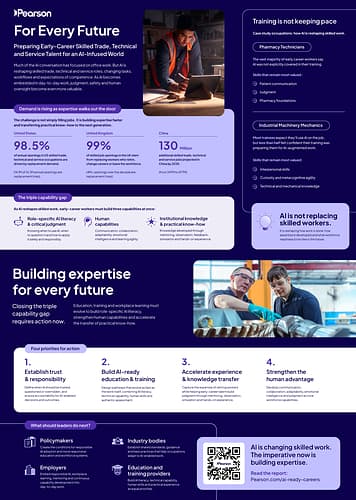
The shift eliminates the entry-level tasks that historically trained young workers and justified hiring people with limited experience. Early evidence shows AI-exposed occupations have seen a 16 percent relative decline in employment for workers ages 22–25, according to Stanford Digital Economy Lab analysis. Organizations that capture AI's efficiency gains without redesigning career onramps risk building workforces with missing lower rungs—and future talent gaps.
The upward shift in work composition
When AI handles monotonous production work, the remaining human tasks become more cross-functional by default. Employees spend less time on routine output and more on synthesis, prioritization, customer nuance, and quality control. This task reallocation concentrates value in work requiring context and tradeoffs—exactly what machines handle poorly.
Smart organizations frame this productivity gain as resilience rather than headcount reduction. When employees own outcomes instead of chores, their roles become more secure. The challenge arrives when managers treat the initial throughput surge as a permanent baseline without establishing operating norms around scope, boundaries, and recovery time.
The entry-level crisis taking shape
The sharpest negative consequence sits in talent pipelines. Entry-level roles historically offered safe arenas for low-risk, repetitive work that taught how businesses operate. Generative AI excels at precisely these starter tasks—basic research, reconciliations, ticket triage, routine reporting.
Separate analysis from Revelio Labs found that higher AI exposure correlates with lower demand for entry-level roles, including an estimated 11 percent drop associated with a 10-point increase in exposure. Companies still need future senior talent, and people still need to build judgment. Erasing easy work without redesigning entry paths creates a structural problem.
Building durable competitive advantage
Effective AI adopters establish guardrails early that protect both throughput and people. They treat intensification as expected and design for it. Apprenticeship-style rotations, supervised AI-first workstreams, and explicit mentoring can recreate the training function that grunt work once provided while capturing automation benefits.
Organizations that redistribute tasks rather than simply eliminate jobs experience more sustainable transitions. At the macro level, research shows strong task-level substitution paired with modest overall employment effects—fewer hours on routine production, more on review and decision-making, plus renewed focus on business problems that automation exposes.
Leaders who preserve deliberate learning loops for young talent while automating monotonous layers turn AI adoption into durable advantage. The goal remains elevating human work, but the missing step involves keeping career ladders intact.
These findings and analysis were detailed in an opinion piece by Gleb Tsipursky, CEO of Disaster Avoidance Experts, published in The Hill.
This is an original analysis by the Omega editorial team. Source reporting: AI Watch.
Want systems like this working for your business?
Book a Call