AI Adoption Creates 'Triple Capability Gap' in Skilled Trades
Workers entering technical and service roles lack AI literacy, human skills, and hands-on expertise as experienced professionals retire.
Workers entering skilled trades face unprecedented skills mismatch
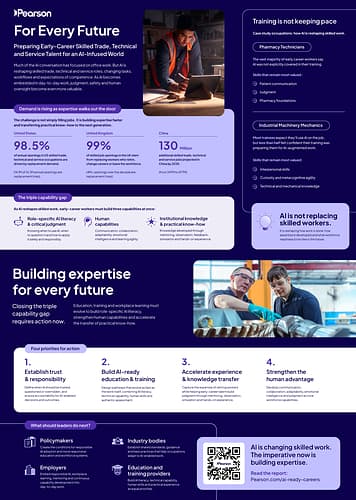
A new workforce challenge is emerging across occupations that keep hospitals, factories, and critical infrastructure running. According to research released by Pearson at the WorldSkills International Conference 2026 in Shanghai, early-career workers in skilled trade, technical, and service roles are entering jobs without three essential capabilities: job-specific AI literacy, irreplaceable human skills, and practical hands-on experience.
The education company warns this "triple capability gap" stems from two converging forces. AI tools are being integrated into these occupations faster than training programs can adapt, while experienced workers are retiring and taking decades of institutional knowledge with them. The result: a generation of workers who may be technologically equipped but lack the judgment and practical expertise their roles demand.
Why it matters
This isn't about abstract future-of-work scenarios. In the UK, 99% of skilled job openings stem from workers retiring or leaving the workforce; in the US, that figure is 98.5%. As these positions turn over, employers need workers who can simultaneously apply AI safely, exercise human judgment AI cannot replicate, and perform tasks traditionally learned through mentorship—a combination current education systems aren't delivering at scale.
AI reshaping roles beyond the office
While much attention has focused on AI's impact on knowledge workers, the technology is rapidly transforming skilled trades. Pharmacy technicians, industrial machinery mechanics, and similar roles now work with AI-enabled tools that require new forms of judgment and oversight.
The pace of change outstrips training systems. One UK pharmacy industry participant told researchers it takes two to three years to revise education standards for pharmacy technicians. Meanwhile, fewer than half of industrial machinery mechanics report their training prepares them for AI-enabled work.
The stakes are high in safety-critical roles. Among surveyed pharmacy technicians, 98% rated exactness and accuracy as extremely important, while 44% described the consequences of error as extremely serious.
Three simultaneous requirements
Pearson's research identifies three capabilities workers now need concurrently:
Role-specific AI literacy: Understanding when to use AI tools, when to question their outputs, and how to apply them safely within their specific occupation.
Human capabilities: Communication, collaboration, adaptability, emotional intelligence, and learning agility—skills that remain distinctly human even as AI handles routine tasks.
Institutional knowledge: The practical expertise traditionally passed from experienced workers to newcomers through observation, mentoring, and hands-on experience.
Sharon Hague, President of English Language Learning and UK CEO at Pearson, framed the challenge: "We're entering a period where many of the workers who keep hospitals, factories and critical infrastructure running will need three things at once: the judgment to work safely with AI, the human skills technology can't replace, and the hands-on expertise traditionally learned from experienced colleagues."
Rethinking expertise development
Closing these gaps requires education, training, and workplace learning to evolve simultaneously. Programs must build role-specific AI literacy and critical judgment, strengthen durable human capabilities, and expand opportunities for practical learning through mentoring, simulation, and hands-on experience.
Without intervention, Pearson cautions, employers will struggle to maintain safety standards and sustain essential services as the gap between workforce capabilities and job requirements widens.
The research combined labor market and AI exposure analysis across the US, UK, and China with surveys, interviews, and roundtables involving employers, educators, students, and early-career workers. Details were first reported by Pearson in the report "For Every Future: Preparing Early-Career Skilled Trade, Technical and Service Talent for an AI-Infused World."
This is an original analysis by the Omega editorial team. Source reporting: AI Watch.
Want systems like this working for your business?
Book a Call