80% of U.S. Factories Still Operate Without Any Automation
Despite aggressive vendor promotion of AI and robotics, the vast majority of American manufacturing facilities have yet to deploy their first automated system.
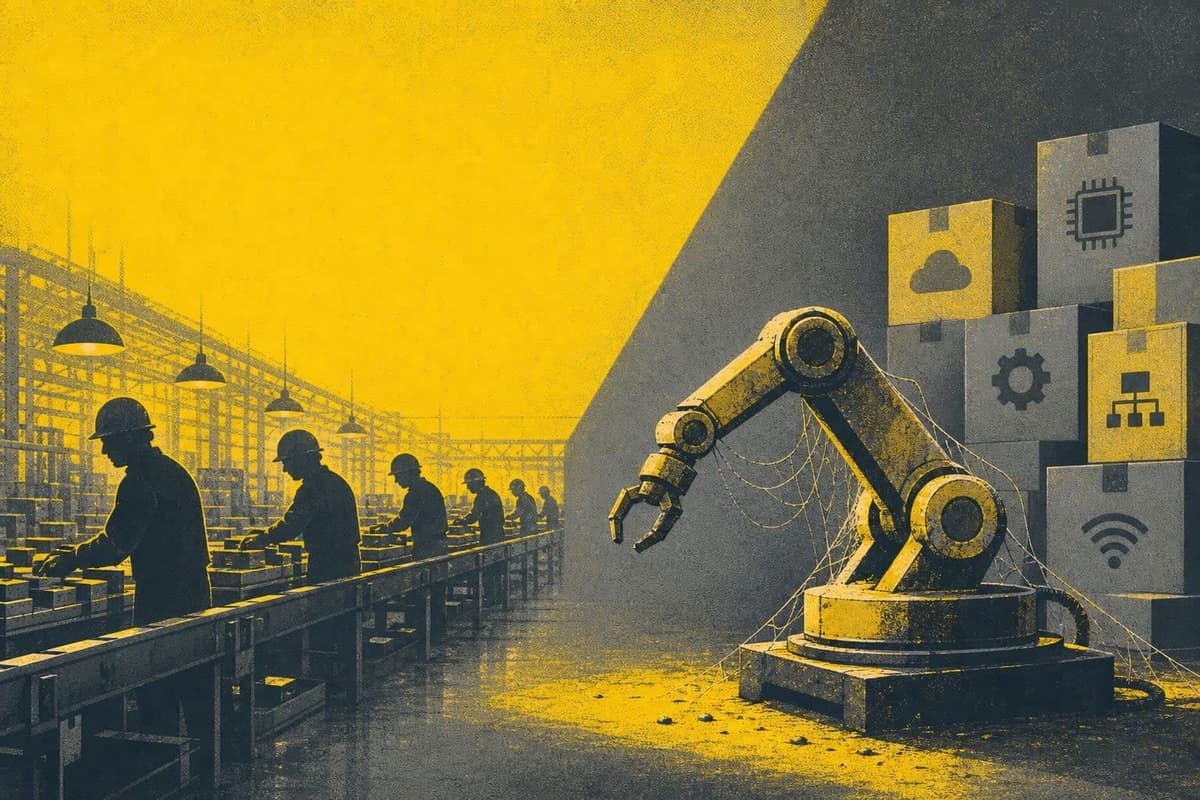
The automation gap widens
Eight in ten U.S. manufacturing facilities currently operate with zero automation, according to Intrinsic Chief Technology Officer Brian Gerkey. That figure, reported by Manufacturing Dive, stands in sharp contrast to the steady stream of AI and robotics product announcements dominating industrial trade media throughout 2025 and into 2026.
The disconnect reveals a fundamental tension in American manufacturing: vendor activity is intense, but factory-floor adoption remains minimal. A 2025 Deloitte Smart Manufacturing and Operations Survey found that 92% of manufacturers believe smart manufacturing will drive competitiveness over the next three years, yet only a small fraction report widespread AI deployment today. Jeff Burnstein, president of the Association for Advancing Automation, told Manufacturing Dive that interest runs high across the industry, but execution remains the sticking point.
The barriers are structural rather than philosophical. Cost, integration complexity, workforce skill gaps, and uncertainty about return on investment all extend decision cycles. For a mid-sized plant manager, moving from spreadsheet-driven scheduling to an AI-connected production line represents an operational transformation that touches every system on the floor, not merely a software purchase.
Why it matters
The 80% figure reframes the industrial AI conversation. Rather than focusing on incremental improvements for already-automated facilities, the real market opportunity lies in helping the vast majority of manufacturers make their first automation deployment. How vendors design entry-level systems, structure business cases, and reduce integration friction will determine whether this gap narrows or persists.
Labor shortages shift the business case
Honeywell CEO Vimal Kapur reframed the automation imperative during a June 2026 appearance on CNBC's Mad Money. Rather than emphasizing efficiency gains, he pointed to workforce demographics. Net workforce size is declining over time, Kapur said, and operators and technicians are already scarce across Honeywell's customer base in hospitals, data centers, LNG plants, and semiconductor fabrication facilities.
"Our customers are looking at it not as a productivity opportunity. They are looking at it as a revenue-generation opportunity," Kapur told CNBC. That distinction matters for procurement teams building business cases. Automation justified as capacity expansion to offset unfillable headcount gaps faces a different approval process than automation positioned purely as a cost reduction measure.
Kapur also argued that Honeywell's existing sensor, controls, and software infrastructure already captures enormous volumes of operational data, and AI now makes that data actionable in previously impossible ways. The timing aligns with Honeywell's strategic restructuring: after spinning off its Solstice Advanced Materials business and separating its aerospace unit, the company has become a pure-play automation firm concentrating investment on building controls, industrial software, and process automation.
Vendors target the zero-automation cohort
A cluster of July 2026 product launches reflects vendor efforts to lower the entry barrier for facilities that have never automated.
ABB extended its all-compatible drive platform to deliver localized motor control in harsh environments—heat, dust, moisture—without requiring separate protective enclosures, according to Automation International. Enclosure costs and installation complexity are common reasons drive deployments get deferred in brownfield facilities.
ARBOR Technology introduced a rugged edge AI platform for machine vision, intelligent transportation, and smart manufacturing applications. Edge platforms that process vision data locally reduce latency and data-transmission costs, two friction points that have historically slowed machine vision adoption on high-speed production lines.
Avalue Technology expanded its integration with the Torizon platform to support embedded Linux lifecycle management and cybersecurity compliance for industrial systems. Cybersecurity compliance increasingly serves as a procurement gate for operational technology systems as manufacturers face sector-specific regulations and customer audits. The company also introduced fanless edge systems optimized for performance per watt, addressing facilities where thermal management and energy costs constrain hardware choices.
Cambrian Robotics and SensoPart announced a partnership combining SensoPart's VISOR hardware with Cambrian's AI software to build a 3D handling system for industrial gripping and positioning. The collaboration addresses a persistent automation pain point: reliably picking and placing parts that vary in orientation or geometry, a task that has historically required expensive custom tooling or extensive robot programming.
These details were first reported by Manufacturing Dive, CNBC, and Automation International.
This is an original analysis by the Omega editorial team. Source reporting: Automation Watch.
Want systems like this working for your business?
Book a Call
