3M's Expanded Beam Optics Cut Data Center Deployment Time by Weeks
A lens-based fiber connector technology addresses AI infrastructure bottlenecks by eliminating precision polishing and dust sensitivity.
A fiber optic solution for AI's infrastructure race
As technology companies compete to build massive AI computing clusters, a seemingly mundane component has emerged as a critical bottleneck: fiber optic connections. Traditional fiber connectors demand painstaking precision—polished surfaces aligned to within microns, vulnerable to contamination from a single dust particle. For data center operators trying to activate thousands of connections quickly, this translates into weeks of specialized labor and frequent rework.
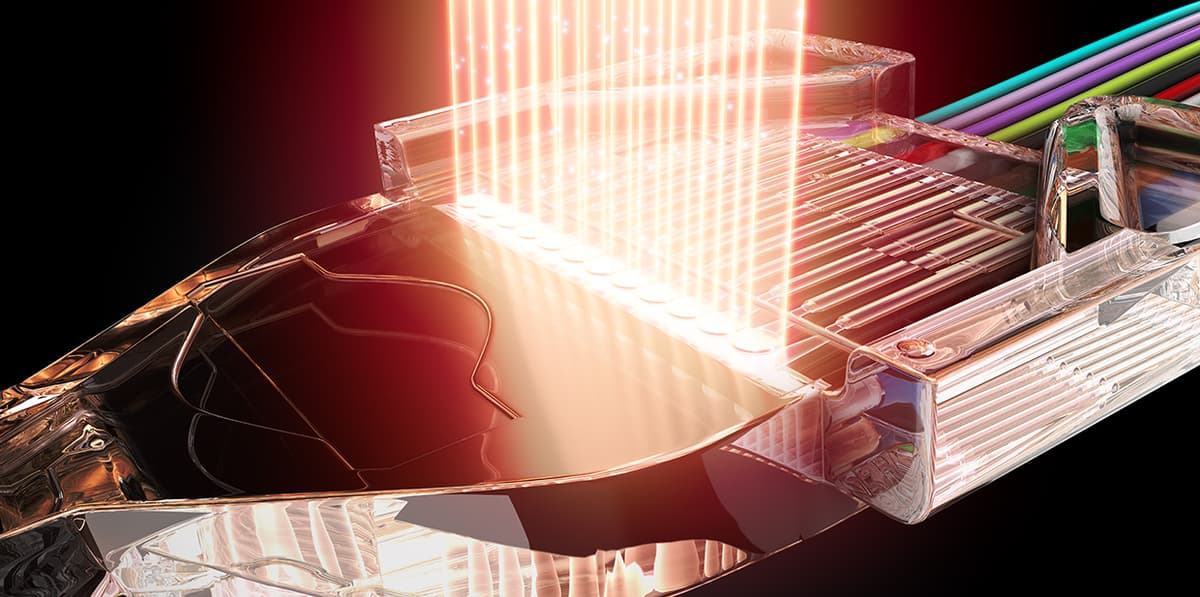
3M has developed a fundamentally different approach. Its Expanded Beam Optical (EBO) technology uses lens arrays embedded in connector ferrules to widen the optical beam at the connection point. By spreading the light signal across a larger area, the system eliminates direct fiber-to-fiber contact and the need for precision polishing. The result is a connector far more tolerant of dust and handling, according to details first reported by 3M.
How expanded beam optics work
Traditional physical-contact fiber connectors require optical pathways to meet at a carefully prepared interface. Any misalignment or surface contamination disrupts the light signal, necessitating inspection and cleaning by trained technicians. This sensitivity creates deployment delays in environments where speed matters most.
The EBO ferrules instead expand the beam before it crosses the connection gap, then refocus it on the receiving end. This wider beam path makes the connection substantially less sensitive to particulates and reduces the need for field inspection. Data center operators report the installation process now resembles plugging in a standard cable rather than executing a precision alignment procedure.
3M introduced the EBO concept in 2019 and engineered it around three requirements: high-density connectivity for compute-intensive environments, manufacturability at hyperscale volumes, and single-mode fiber compatibility. The company became the first to demonstrate single-mode expanded beam technology at production scale, according to Alex An, vice president of the Data Center Vertical at 3M.
Why it matters
Early deployments show network bring-up timelines compressed from weeks to days. For hyperscalers racing to train next-generation AI models, that time advantage directly affects competitive positioning. The technology addresses a constraint that has limited how quickly companies can activate new computing capacity—a particularly acute problem as AI workloads drive unprecedented demand for data center infrastructure.
From pilot programs to production standard
Customers testing EBO ferrules in live data center environments report strong signal performance despite routine dust exposure and handling conditions. Some operators who initially approached the technology cautiously during pilot phases now consider it essential, telling 3M they cannot envision reverting to traditional connectors.
The technology emerged from coordination across 3M's materials science, precision manufacturing, and supply chain teams. The company positions EBO as the foundation of a broader data center connectivity roadmap, with additional solutions planned to address infrastructure challenges facing AI operators.
These details were first reported by 3M in a company announcement about the technology's development and early customer deployments.
This is an original analysis by the Omega editorial team. Source reporting: AI Watch.
Want systems like this working for your business?
Book a Call