1872 Launches AI-Driven Metal Fab Startup With $15M Seed Round
Former SpaceX engineers aim to eliminate WIP bottlenecks by connecting autonomous welding, cutting, and material handling into continuous production flow.
A new approach to metal fabrication
A Cincinnati-based startup called 1872 formally launched in July 2026 with a bold premise: use AI and autonomous manufacturing to compress metal fabrication lead times from weeks to hours. The company secured $15 million in seed funding from The Ohio High Growth Investment Opportunities Fund, led by investor Mark Kvamme.
The venture was founded by three former SpaceX engineers—Dan Summers (CEO), Brian Mongilio, and Michael Grant—who bring a product-development mindset honed in aerospace to the metal fabrication industry. Their goal is to build an integrated production system that eliminates the islands of automation common in today's job shops.
Why it matters
Most fabricators achieve strong local efficiency—fast cutting, quality welding—but struggle with global throughput. Parts spend the majority of their time as work-in-process between operations. By designing a factory around software orchestration and continuous material flow, 1872 aims to prove that high-mix fabrication can achieve both speed and scale without sacrificing flexibility.
Software as the backbone
At the core of 1872's operation is FactoryOS, a proprietary platform with two components. Architect ingests 3D designs and plans production sequences, while Conductor functions as a manufacturing execution system that autonomously controls floor operations. The software is designed to integrate deeply with open-architecture machines, enabling real-time coordination across cutting, welding, and material handling.
Path Robotics, which supplies autonomous welding systems under a Robot-as-a-Service model, is a key technology partner. Path's Obsidian neural network enables robots to weld without manual programming, handling high-mix applications. According to Path CEO Andy Lonsberry, the RaaS model aligns well with 1872's vision, allowing continuous hardware and software improvements based on production feedback.
The insight that sparked 1872 came from utilization data Path observed in customer facilities. Autonomous welding cells performed well but remained underutilized because material flow and upstream processes weren't synchronized. Kvamme, an early Path investor, connected with Summers in September 2025 to explore whether a fabrication operation built from scratch around automation could solve that problem.
Phased automation rollout
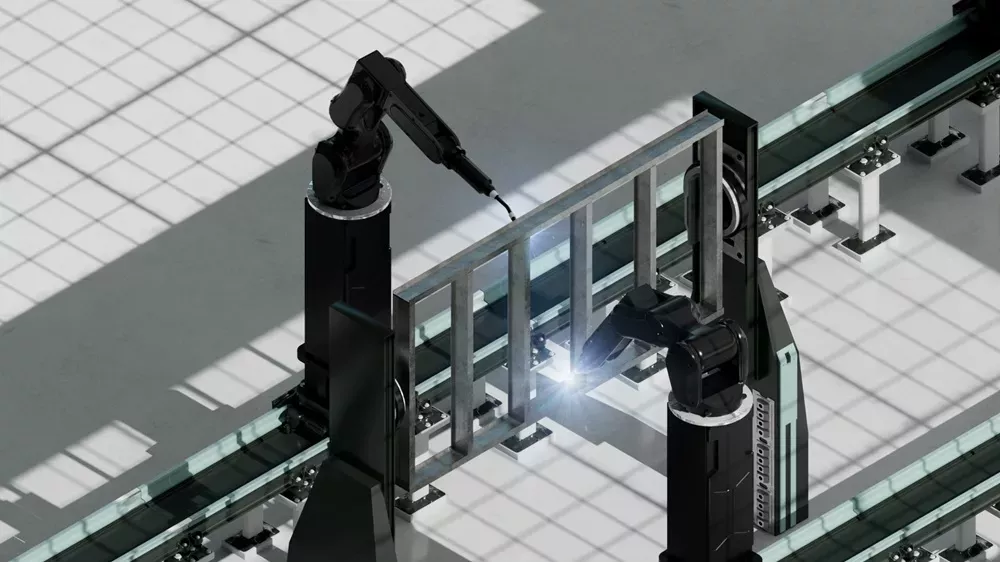
1872 will initially focus on rectangular welded structures—skids and frames made from structural tube—serving infrastructure and industrial sectors. Raw material arrives at the dock, moves to plasma cutting (with potential tube laser addition), then to fitting, tacking, and autonomous welding via Path cells, followed by postweld grinding.
Summers emphasized that automation will be incremental. The first 12 months will focus on matching best-in-class fabricators on cost, quality, and lead time. From there, the team will automate material handling between work centers using pick-and-place systems and automated guided vehicles that move kits directly from cutting to welding.
The company's three-stage production model includes: modeling (creating high-fidelity 3D CAD with embedded manufacturing logic), orchestration (automated scheduling driven by asset utilization), and execution (robots fabricating per plan). Arc-on-time at the welding cells will be the pacing metric.
Summers, who worked at SpaceX from 2015 to 2022, noted that his former employer succeeded by tightly coupling product design with manufacturing systems. That same philosophy underpins 1872's approach: iterative development of both the product and the production system, accelerated by AI.
Details of the launch were first reported by The Fabricator.
This is an original analysis by the Omega editorial team. Source reporting: Automation Watch.
Want systems like this working for your business?
Book a Call